
Catching Clouds – Piano, Violin, Viola (or Violin), Cello
Watch this “scrolling score” video to see the sheet music while an audio demo plays. An mp3 audio file is included with the sheet music download.
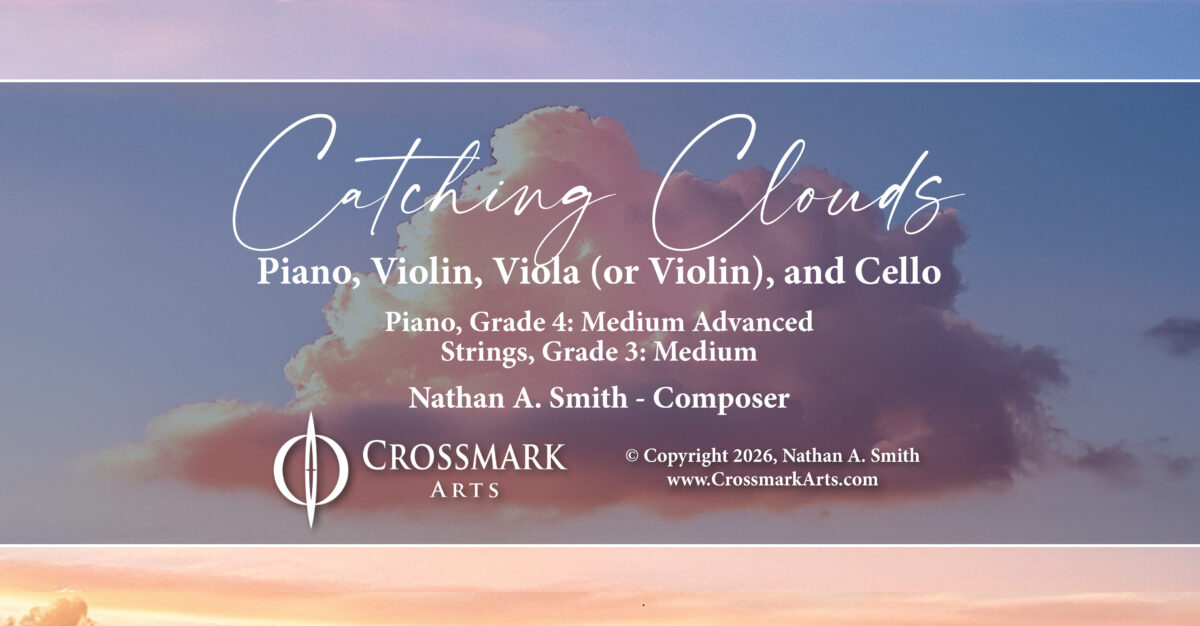
Catching Clouds – Free Piano Quartet Sheet Music Download
Nathan A. Smith, Composer
Piano Quartet: Piano, Violin, Viola (or Violin), and Cello
“Catching Clouds”, composed by Nathan A. Smith of Portland, Oregon, is a musical exploration of those rare, exhilarating moments in life that feel almost too good to be true.
The piece opens with a brisk, driving energy in the piano — a rhythmic ‘whisking’ off the ground that sets the stage for a journey into the sky.
As the violin and cello join in, the melody begins to sail, capturing the breathless surprise of riding a breeze. You can hear the music “brushing the sun” as the strings climb into their higher registers, creating a sense of being suspended in a dream of light and air.
Throughout the piece, the swirls of flight are depicted in the rolling melody passed among instruments as well as diving scales within the strings.
The middle section turns contemplative to signal the “thinning” of the clouds as evening approaches. The music eventually returns to the main theme, reflecting the realization that while we cannot stay in the heights forever, the memory of the joyful experience remains a permanent gift.
Inspiration
“Catching Clouds” is a tribute to the people and places that have “fondly kissed” our lives. It invites us to hold onto our best memories with gratitude, even as we reach toward the next horizon.
The music depicts the poem the composer wrote called “I Caught A Cloud”:
I CAUGHT A CLOUD
by Nathan A. Smith
Yesterday, I caught a cloud while stretching toward the sky.
It briskly whisked me off the ground, swooping my surprise.
Gleefully, I rode it ‘round, sailing on the breeze,
careless of my life below, a dream of downy ease.
Flung among the skybirds, then swung below a rainbow,
I rushed so high, I brushed the sun, hung in flows of amber glow.
As evening blushed in fuchsia hues, my cloud whorled wispy thin,
drifting gently to the ground, my lowly home again.
I long once more to drift those heights, but clouds are just a moment’s mist.
The gift is the lifting memory of places, people, fondly kissed,
and all the clouds I might have missed if I hadn’t touched the sky.
Technical Details & Pedagogy
- PIANO DIFFICULTY: Grade 4 Medium Advanced — Ideal for high school and above, requiring left-hand endurance, balancing an accented driving rhythm while maintaining a flowing feel.
- STRINGS DIFFICULTY: Grade 3 Medium — Ideal for junior high, high school or community ensembles, focusing on lyrical phrasing and shifting between rhythmic support and melodic leadership.
- Key & Tonality: The work is set in E Major. It utilizes frequent accidentals and melodic minor inflections to create an “ethereal” tonal palette, particularly in the developmental sections at Rehearsal Letters [C] and [F].
- Meter & Rhythmic Complexity: The piece remains in a consistent 4/4 time signature. The complexity arises from the interplay of straight eighth-note driving patterns in the piano against syncopated and tied melodic lines in the strings.
- Duration: 3 minutes
- Tempo: Quarter Note = 140
- Instrumentation: Piano, Violin, Viola (with optional Violin replacement), and Cello
- Pedagogical Uses:
- Rhythmic Drive and Tempo Maintenance
The primary challenge is maintaining the energetic q=140 pulse without rushing during the more lyrical string entries. Educators can use this to teach:- Subdivision as an Anchor: Using the piano’s constant eighth-note “engine” to help string players place syncopated entrances accurately.
- Consistent Forward Motion: Keeping the energy “off the ground” during softer passages.
- Articulation and Narrative Arc
The score uses specific markings to contrast the “lifting” sensation of the flight with the “grounded” return to home:- Accented Momentum: The use of marcato-style accents in the piano at Rehearsal Letters [A] and [D] teaches students how to provide a percussive, rhythmic foundation.
- Expressive Transitions: Managing the ritardando sections at measures 64 and 87 requires the ensemble to follow the piano’s lead to create a natural, “drifting” deceleration.
- Ensemble Balance and Texture
The roles of the instruments shift to mirror the poem’s journey from “surprise” to “gratitude”:- Soloistic Projection: In sections [B] and [E], the cello and violin take over primary melodic duties, requiring the piano to balance its driving rhythm against the strings’ soaring lines.
- Tonal Warmth: The final a tempo at Rehearsal Letter [I] and the concluding fermata teach the ensemble to shift from the “thrill” of the flight to a lush, resonant chordal blend.
- Rhythmic Drive and Tempo Maintenance
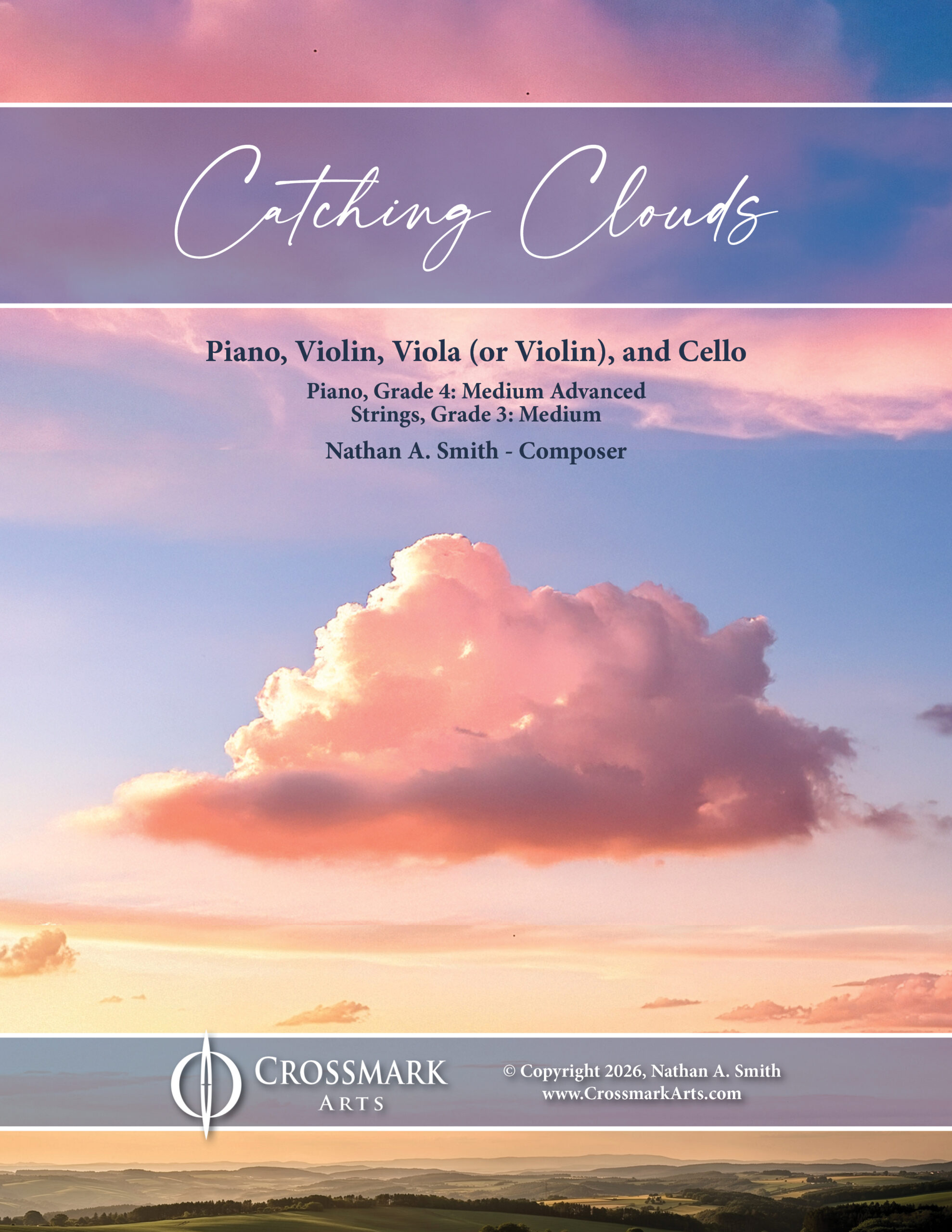
DOWNLOAD
Includes sheet music PDF of full score, plus individual parts for piano, violin, viola and cello. Also includes audio demonstration MP3 and and optional violin replacement part for viola.
Planning to perform this piece? Please let Nathan know and, if possible, provide a recording of the performance for his enjoyment!