
River Crossing – Piano, Violin, Viola (or Violin), Cello
Watch this “scrolling score” video to see the sheet music while an audio demo plays. An mp3 audio file is included with the sheet music download.
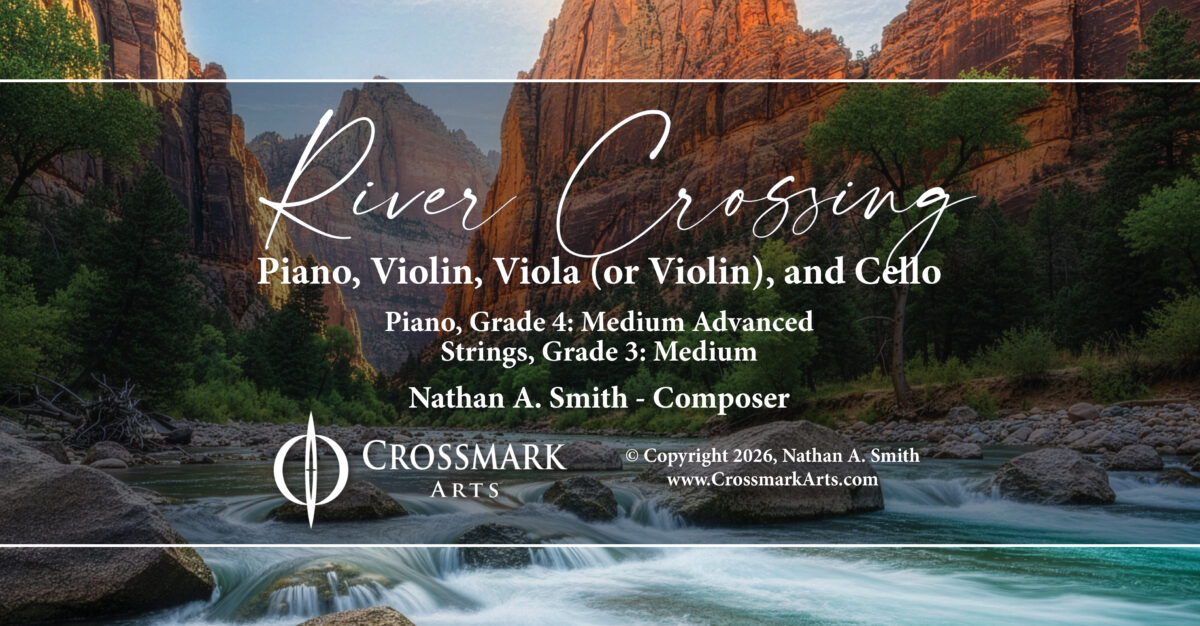
River Crossing – Free Piano Quartet Music Download
Nathan A. Smith, Composer
Piano Quartet: Piano, Violin, Viola (or Violin), and Cello
“River Crossing” is a high-energy, cinematic work for piano and strings that serves as a musical tribute to the pioneers of the Oregon Trail. Inspired by the composer’s own move from Ohio to Portland over 20 years ago, the piece captures the dual sense of adventure and the profound uncertainty of leaving everything behind.
The “crossing” of the title refers to endless rivers crossed on the Oregon Trail, but also about the metaphorical “point of no return” — the moment one overcomes a significant obstacle and steps into a new life.
The composition follows an evocative narrative arc:
The Vast Frontier — Rehearsal Letter [A]: The piece opens with a bold, western-style rhythm reminiscent of classic film scores. The shifting meters and driving 1/8th note = 310 tempo evoke imagery of the vast plains and desert vistas crossed by a wagon train.
The Promise of the Future — Rehearsal Letter [B], [D] and [G]: The energy shifts at Letter [B] as the piano takes on a more melodic role. This section moves from the landscape to the individuals, representing those thinking excitedly about their future and the promise of a new beginning.
Memories of Home — Rehearsal Letters [E] and [H]: In these quieter, 3/4 “waltz” sections, the music takes a reflective turn. This represents the pioneers looking backward to the family and friends they left behind, acknowledging the bittersweet nature of the journey before the forward momentum returns.
The Final Destination — Rehearsal Letter [I] to the end: The main theme returns and builds in intensity, signifying the relentless push toward the horizon. The piece concludes with a sense of triumph and relief—a musical “safe arrival” in a new land.
Technical Details & Pedagogy
- Instrumentation: Piano with violin, viola and cello. An optional second violin part is provided as a substitution for viola, if needed.
- Performance Duration: About 3 to 3 1/2 minutes
- Difficulty Level:
- FOR PIANO: Grade 4 Medium Advanced — Ideal for high school and above, requiring rapid-fire rhythms and modulations.
- FOR STRINGS: Grade 3 Medium — Ideal for junior high, high school or community ensembles, focusing on lush lyrical phrases and supportive harmonies.
- Key & Tonality: The work primarily utilizes G Major. It features significant modal shifts and accidentals, particularly in the reflective 3/4 sections at Rehearsal Letters [E] and [H].
- Meter & Rhythmic Complexity: Frequent metric modulations between 6/8, 2/4, and 3/4.Constant eighth-note pulse requirements across all parts.
- Pedagogical Applications
- Rhythmic Vitality and Metric Modulation
The primary challenge in this piece is maintaining a rock-solid eighth-note pulse (1/8th note = 310) while the meter shifts under the players’ feet. Educators can use this to teach:- Subdivision at High Tempos: Ensuring the eighth note remains the constant “anchor” when moving from the duple feel of 2/4 to the compound feel of 6/8.
- Narrative Dynamics and Articulation
The score uses specific articulations to differentiate between the “vast landscape” and “personal stories” within the wagons:- Aggressive Marcato: The use of accents and f dynamics at Rehearsal Letter [A] and [C] teaches students how to play with a percussive, cinematic edge.
- Lyrical Contrast: The transition to p and pp in the 3/4 sections at Rehearsal Letters [E] and [H] requires string players to shift from rhythmic “engine” playing to expressive, sustained melodic lines.
- Ensemble Balance and Texture
The interplay between the piano and strings shifts roles throughout the journey, offering several “teaching moments”:- Projection vs. Support: In the [B] and [D] sections, the piano moves to a melodic role , requiring string players to master the art of supportive, transparent accompaniment.
- Unified Transitions: Executing the final ritardando into the fermata teaches the ensemble to “breathe” together, signaling the collective relief of a safe arrival.
- Rhythmic Vitality and Metric Modulation

DOWNLOAD
Includes sheet music PDF, audio demonstration MP3, and optional violin replacement part for viola.
Planning to perform this piece? Please let Nathan know and, if possible, provide a recording of the performance for his enjoyment!